Child Autism Assessments
A structured, compassionate and neuroaffirming autism assessment pathway.
Our autism assessments are designed to be thorough, respectful and grounded in best‑practice neurodevelopmental standards. We follow NICE guidelines, use validated tools, and use multidisciplinary decision‑making and a warm, child‑centred approach.
Our Assessment Process
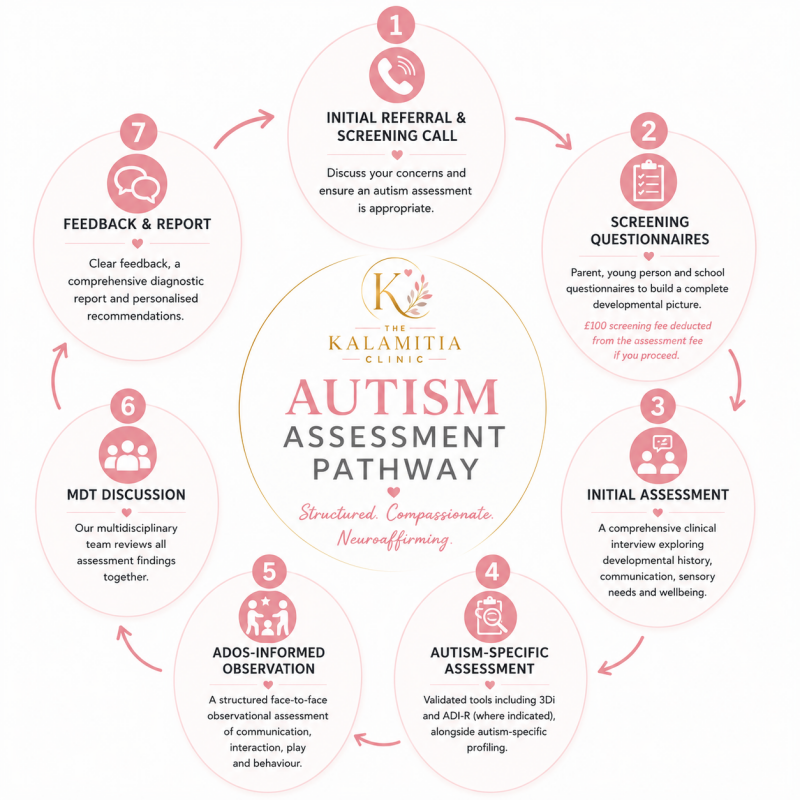
1. Initial referral & screening call
We begin with a screening call to understand your concerns, explore your child’s developmental profile and ensure an autism assessment is appropriate.
2. Screening questionnaires
Parent, young person and school questionnaires help us gather a full picture of your child’s communication, sensory profile, behaviour, strengths and challenges.
A £100 screening fee applies for autism and ADHD assessments. This is deducted from the final assessment cost if you proceed.
3. Initial assessment
A comprehensive clinical interview with parent/carer and young person. We explore developmental history, social communication, sensory needs, routines, interests, emotional wellbeing and any co‑occurring conditions.
This session is collaborative, gentle and paced to support comfort and trust.

4. Autism‑specific assessment
We use validated diagnostic tools to explore autistic traits and developmental history:
-
3Di (Developmental, Dimensional & Diagnostic Interview)
-
ADI‑R
These tools help us understand communication, interaction, flexibility, sensory experiences and developmental patterns. “Our clinician will use either the 3Di or the ADI‑R, depending on their clinical judgement. Both tools explore the same core diagnostic areas, but use different interview formats.”
3Di
(Developmental, Dimensional & Diagnostic Interview)
The 3Di is a detailed, structured developmental interview used to assess autism. It explores:
-
Early developmental history
-
Social communication and interaction
-
Flexibility, routines and interests
-
Sensory experiences
-
Behaviour across different settings
It provides a rich, nuanced understanding of a young person’s developmental profile and autistic traits.
ADI‑R (Autism Diagnostic Interview – Revised)
The ADI‑R is a gold‑standard autism assessment tool used worldwide. It focuses on:
-
Communication
-
Social interaction
-
Repetitive behaviours and interests
-
Developmental milestones
It is particularly helpful for complex presentations, girls and young women, and situations where early developmental detail is essential.
5. ADOS‑informed face‑to‑face observation
A structured, in‑person observational session designed to understand:
-
Social communication
-
Interaction
-
Play
-
Imagination
-
Behaviour
-
Sensory responses
The ADOS is one of the most widely recognised autism assessment tools. Our clinic uses an ADOS‑informed observational session, which means:
-
A structured, in‑person interaction
-
Activities designed to observe communication, social reciprocity, play and imagination
-
A warm, supportive environment tailored to the young person
-
Clinically informed observation without requiring the full ADOS battery

This approach is child‑centred, flexible and neuroaffirming, while still grounded in recognised diagnostic standards.
6. Multidisciplinary team (MDT) discussion
Your child’s assessment is reviewed by our multidisciplinary team to ensure a robust, fair and collaborative diagnostic process.

7. Feedback session & comprehensive report
You will receive:
-
Clear verbal feedback
-
A detailed diagnostic report
-
Tailored recommendations for home, school and wellbeing
-
Signposting to support, interventions and next steps
Our reports are designed to be practical, accessible and supportive for families, schools and professionals.
Our approach
We provide autism assessments that are:
-
Neuroaffirming — celebrating strengths, identity and individuality
-
Holistic — considering sensory needs, mental health, trauma, learning and environment
-
Evidence‑based — using validated tools and structured clinical reasoning
-
Compassionate — ensuring young people feel safe, respected and understood
Your journey, our support. We are here to guide you and your family with care, clarity and expertise.